




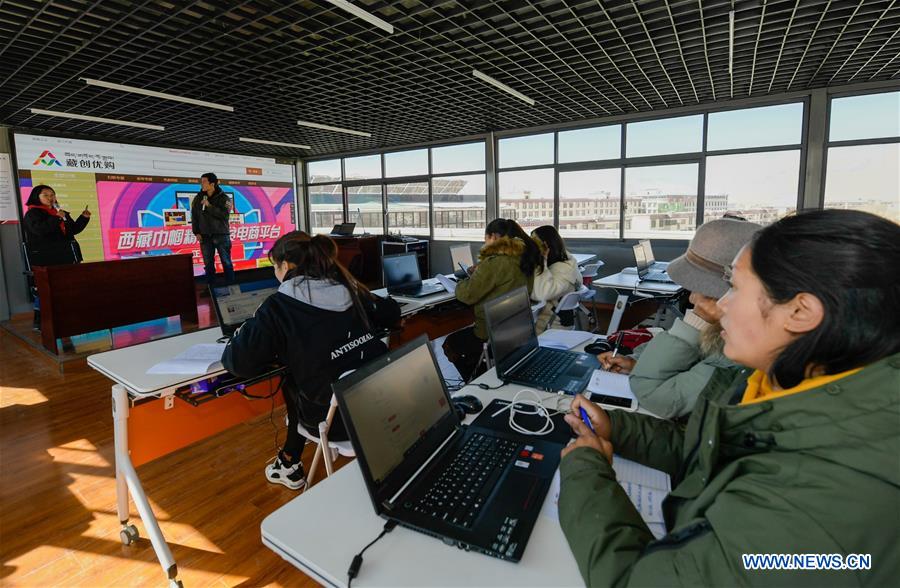
An e-commerce training course for poverty alleviation is held in Lhasa, capital of southwest China's Tibet Autonomous Region, Jan. 11, 2018. (Xinhua/Liu Dongjun)
LHASA, March 27 (Xinhua) -- For the older Tibetans, the memory of bondage and abuse in an era resembling the Middle Ages, and the experience of freedom and prosperity in modern Tibet coexist.
Thursday marks the 60th anniversary of democratic reform that abolished ruthless theocracy and serfdom, and established a socialist system that has seen booming economic, political, religious, cultural and social development on the plateau.
"By abolishing serfdom, a grim and backward feudal system, Tibet was able to establish a new social system that liberated the people and made them the masters of the nation and society, thus ensuring their rights in all matters," says a white paper, titled "Democratic Reform in Tibet -- Sixty Years On," published Wednesday.
Today, the crimson-and-white Potala Palace overlooks Lhasa, the capital of the Tibet Autonomous Region, a city that emerged from stifling rule of theocracy and is thriving under the governance of the Communist Party of China.
On Wednesday morning, chilly air traveled through Lhasa. Streets are adorned with red lanterns and brightly-colored flags. Workers set up a grand stage for a celebration Thursday at the foot of the Potala Palace and arranged a sound system to play traditional Tibetan music.
In Lhasa, devout Buddhists, with prayer wheels in their hands, walked in slow steps, while students and white-collar workers hurried on their way to school and the office.
Starting this year, special funding of 300 million yuan (about 45 million U.S. dollars) will be spent on thousands of precious antique books from the Buddhist canon stored at the Potala Palace. The investment is the latest effort to conserve and explore the modern value of the world heritage and icon of Tibetan Buddhism, which was once off-limits palace to the public.
Across the region, Tibet is thriving on a path of rapid modernization, balanced by efforts to preserve age-old traditions, culture and religion.
TURN OVER THE DARK CHAPTER
A region locked by high mountains, Tibet is now home to around 3.44 million people.
It is already the consensus of Tibetologists that the democratic reform, which started in 1959, gave personal freedom, right to serfs' life, human dignity and value to the people, and unleashed immense and consistent productive forces for years to come.
Tibet of 60 years ago was never the spiritual utopia trumpeted in adventure books written by authors from the West.
Wangdu, 70, was born as a serf in Jora Township, Shannan city. "Each day was spent working and working, non-stop," he said.
Wangdu and his family belonged to the 95 percent of the population who were serfs under rule of the upper class, who made up the remaining 5 percent.
Wangdu was 10 when the democratic reform started. His family received 2.6 hectares of land and more than 100 cows. Across the region, 180,000 hectares of land were redistributed in the reforms and serfs were freed from subjugation.
A young herder, he never learned how to farm, but the ownership of property felt refreshing. "I was very keen on learning how to grow crops because they were on my own property," he said.
Now living in a border village in Shannan, Wangdu, wearing a long white beard, owns a hotel and leads a leisurely life. Banking on booming tourism, Wangdu makes more than 1,000 yuan from a single guest who stays for a few days at the hotel.
"Life is treating me well. I can't complain," he said. He likes to wear gold and silver rings, the type of ornaments that he once saw on the fingers of aristocrats.
Like Wangdu, most people who have memories of serfdom are aged 70 or more, and Tibet has distanced itself from its past. But families in Tibet still share the common memory of dire suffering and regard it as the best justification for the need to reform.
Padma Chozin was born in 1959, the same year the reform started, so she never had to sleep near a cowshed and work without pay, like her big brother Tenzin Chophel did.
The siblings' parents lived on an estate that belonged to an official of then Tibetan local government Surkhang Wangchen Geleg. Tenzin Chophel's childhood memories are about constant starvation.
"I had to sleep on top of the bellies of my parents. It was such a small place," he said.
Three days after Padma Chozin was born, the democratic reform started and the herders and farmers association redistributed the serf owner's land and cattle to the public.
After the reform, Tibetans like Padma Chozin refused to accept subjugation as a way of living. Life began to change rapidly for the better.
Padma Chozin was sent to school by her father and at age 16 became the first medical professional in her home of Damxoi Village. She worked for over 30 years as a pediatrician before her retirement five years ago.
Now her extended family has more than 70 people, with different careers such as sanitation workers, teachers, civil servants, entrepreneurs and drivers.
"The democratic reform changed the path of our family. The dark days of the past are long gone but will never be forgotten," she said.
NEW ERA FOR TIBET
In the democratic reform, the central government fully considered Tibet's status as an ethnic and border region with deep religious traditions, said Zhang Yun, director of the Institute of History at China Tibetology Research Center.
In 1965, a system of regional ethnic autonomy came into practice in Tibet to ensure the rights of ethnic groups in political, economic, cultural and social fields.
Tibetan people became masters of their own affairs. According to the white paper, there are 35,963 deputies to the people's congresses at all levels in Tibet. Of them, deputies from Tibetan and other ethnic minority groups account for over 92 percent.
Tibet's local legislature made over 300 regulations on preserving the ethnic language, cultivating ethnic cadres, and ensuring freedom of religion, Zhang said.
One of the bills is to regulate sky burials, a Tibetan tradition in which bodies are fed to vultures and other predatory birds. It is taken as an act of generosity and a ritual that allows the soul to ascend to heaven.
In March this year, Tibet sent 19 delegates and 30 political advisors to the annual sessions of the 13th National People's Congress (NPC) and the 13th National Committee of the Chinese People's Political Consultative Conference (CPPCC).
Thubten Khedrup, one of the advisors and an economics professor from Tibet University, has presented nearly 200 proposals both at the regional level and national level since first elected as a political advisor in 1998.
"I'm eager to know more about my hometown Tibet, and hope it becomes better," Thubten Khedrup said. "So finding problems in the development of Tibet and coming up with solutions is how I fulfill my obligation as a political advisor."
Besides a modern economic, political and cultural system that shepherds the development of the region, another boost for Tibet comes from the central government. In the past six decades, the central government has convened six conferences on Tibet.
During the 13th Five-year period (2016-2020), a total of 657.6 billion yuan of central finance was earmarked for the construction of major infrastructure in Tibet.
"No other countries in the world have channeled such huge support for a specific area," Zhang said.
The economic support has served well in solving the conflict between economic development and environmental protection, a priority at the roof of the world, with its fragile natural environment.
Tibet has 47 nature reserves. Economic projects are off-limits or strictly controlled on more than 800,000 square kilometers, roughly two-thirds of the region's land area.
To this day, a modern Tibet is in the making. Agriculture and herding sectors are becoming highly mechanized and modernized. The region's industrial economic volume is expanding. Roads, airports, railways, bridges, and pipelines as part of a highly efficient transport network are established. Tibet is increasing its connection with the rest of the world and opening up.
Tibet is seeking high-quality development. It has prioritized seven industries: the digital industry, plateau biological industry, tourism and culture, clean energy resources, green industry, modern services and border trade. The region targets 30-percent growth in the digital economy this year.
Tibet is full of vigor like never before, said Norbu Dondrup, vice chairman of the regional government, Wednesday.
MODERATE PROSPERITY AND BEYOND
Tsering Yudron, 9, dances breezy steps with playmates at the Qamdo Experimental School. She has little idea about Xiaokang, or a moderate prosperous society, which is China's national target for 2020, but her father Norbu Tsering is adamant that his village has met the target.
Norbu Tsering, 55, is the Communist Party secretary of Tatok Village in Qamdo. Row after row of spacious houses are built up the mountains in his village.
In the past 20 years, people in the village emerged from poverty by working in construction, transport and opening factories to process roasted barley flour. The average income of a family is 12,724 yuan, far above the national poverty line of 2,300 yuan.
"You never have to worry about food or clothes, or lack anything. I think that is prosperity," he said.
Well-off retirees in the village are not hesitant when they purchase items of a personal liking. Tsering Tashi spent 2,700 yuan on a stereo to listen to Tibetan music.
"When I sip a cup of tea and listen to the radio and music, and have nothing to worry about, I think that is what a prosperous life should be," he said.
Last year, 180,000 people in Tibet were lifted out of poverty, bringing the region's poor population down to 150,000 from 860,000 six years ago. The poverty rate lowered to less than 8 percent. Industries are being developed to create jobs and bring sustainable earnings for rural people.
The Drache Village in Nyingchi is known as a village of truck owners. Over 80 percent of households own trucks and lease them for logistical use. A village-owned company makes concrete slabs and other construction materials. Each family receives as much as 300,000 yuan in dividends per year.
Rural Tibetans who used to depend on herding and hunting are hired in environmental protection jobs.
Danyaan, 43, in the Nanyi Lhoba ethnic autonomous township in Nyingchi, was a hunter until he was 16 years old. Now he is a forest ranger patrolling near Nanyi scenic spot, a popular tourist destination.
"With dividends from the village tour company, and patroller allowances, I make over 100,000 yuan a year," he said.
Moderate prosperity is a target, but it does not mean that people can rest and work no more. Tibet still has a long way to improve the livelihood of the people and advance on the path of modernization, Zhang Yun said.
"Tibet has no shortage of people who have the right knowledge and ability to realize their dreams. Many young people are open-minded with sharp visions. They will bring about more changes in the future," he said.
(Video editor: Yin Le)
